
Sewer Allocation in Cabarrus County: What Landowners Need to Know Before They Sell Commercial Land
If you own land in Cabarrus County and plan a commercial, industrial or larger residential project, sewer capacity may shape your timeline more than zoning does. The Rocky River Regional Wastewater Treatment Plant has limited room for new flow, and the towns it serves now ration that capacity one project at a time.
Having the right zoning and a buyer or tenant ready doesn’t guarantee that you can build. This post covers how the system got here, how allocation works today, and what to expect as the plant expands.
How we got here: from first come, first served to rationing
For years, sewer capacity in Cabarrus County was handed out on a first-come, first-served basis. The Water and Sewer Authority of Cabarrus County (WSACC), created in 1992, treats wastewater for the county’s towns at the Rocky River Regional Wastewater Treatment Plant in Concord. If a project met the technical requirements and the plant had room, it got service.
Growth eventually outran the plant. In October 2021, Charlotte Water reached the maximum flow it was allowed to send into the WSACC system from parts of Charlotte, Huntersville, Cornelius and Davidson. The next month, WSACC and its member governments signed an interlocal agreement that divides the plant’s capacity among the jurisdictions (Kannapolis allocation policy).
Since then, each town decides for itself which projects get a piece of its share. Some in the development community have pushed for a return to first come, first served, but for now, allocation is a local political decision.
How allocation works now: every town has its own rules
There is no single process in Cabarrus County. Each town sets its own rules for handing out its share of WSACC capacity. In most, you submit a sewer allocation application that the city council and mayor review and vote on.
Here is how the three largest towns handle it:
| Town | Who decides | How often | Key rules |
|---|---|---|---|
| Concord | City Council | Quarterly: March, June, September, December | Council members score each project 0 to 5; set-asides by land use; approvals last one year |
| Kannapolis | City Council approves the allocation list | Every six months, after WSACC’s capacity updates | Scoring matrix for non-residential projects; new applications join a wait list |
| Harrisburg | Staff allocation committee; Town Council for economic development projects | Quarterly | Points system; at least 30% of capacity reserved for economic development |
A closer look at Concord
Concord’s policy, last updated in June 2026, shows how competitive the process has become:
- Scoring: Each council member scores each project from 0 to 5. A 0 means they don’t support the project, and a 5 means full support. Council averages all members’ scores, and projects averaging 2.75 or higher are considered for approval.
- Set-asides: At least 350,000 gallons per day is held for economic development projects. Of the rest, 35% goes to residential, 55% to non-residential and 10% to mixed use.
- Residential limits: Residential approvals may be phased at up to 50 units per year within a project.
- Spec industrial caps: Speculative buildings under 75,000 SF can request up to 7,500 gallons per day per phase. Larger buildings in I-2 zoning can request up to 12,500 gallons per day per building.
- Expiration: A preliminary allocation lasts one year, with one six-month extension. The project’s scope can’t change significantly after approval.
The next application deadline is January 19, 2027, for council’s March 23 meeting.
Where experience makes the difference
A policy document tells you the rules, but not how a council actually weighs a project. Our firm has been awarded sewer allocation on multiple projects, and we meet regularly with council members and mayors across the region to move projects forward.
Projects where we’ve secured sewer allocation in Concord include:
- 4460 Weddington Road
- 360 Old Salisbury-Concord Road
- 2793 Zion Church Road
- 510 Pitts School Road
- 497 Woodhaven Place
- 3010 New Town Way SW
Spotlight: Nicolock Paving Stones, 3010 New Town Way SW
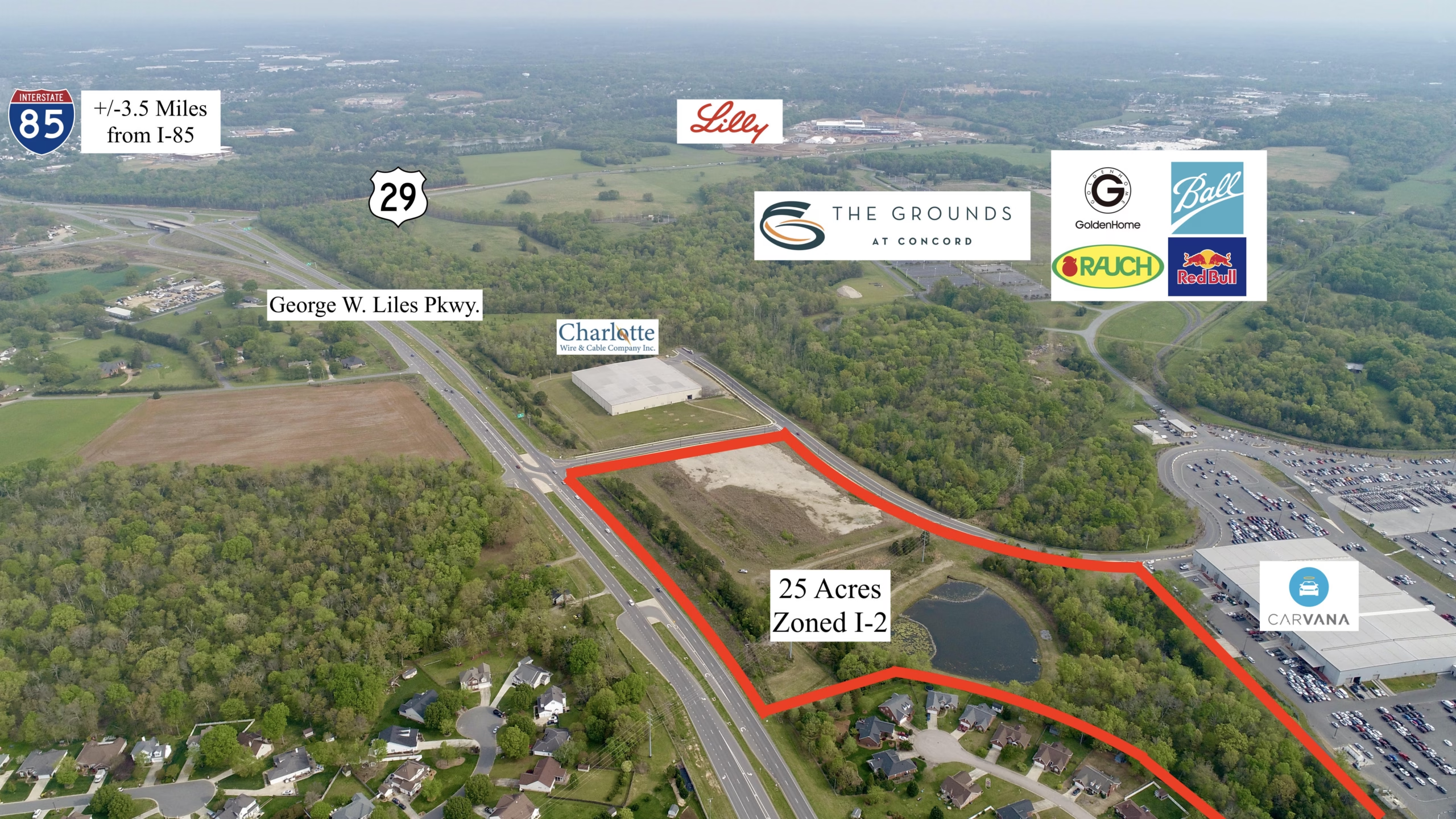
One of those sites is about 25 acres at 3010 New Town Way SW, near George W. Liles Parkway and US 29 and about 3.5 miles from I-85. The buyer, Long Island-based Nicolock Paving Stones, chose it for a roughly 51,000-square-foot plant that makes concrete pavers, retaining walls and other landscape products. The plant is part of a $25 million North Carolina expansion the company announced in 2024, and it will serve customers as far away as Virginia and Tennessee.
According to the City of Concord, the project brings about 30 full-time jobs with average salaries of $65,000 to $75,000. Getting there took more than a sewer allocation. Part of the land was zoned for agriculture and went through rezoning, and the site plan calls for heavy-duty concrete paving for truck traffic and new stormwater controls. This is the kind of investment sewer capacity makes possible, and the kind that stalls without it.
Along the way, we’ve learned several tricks of the trade that improve a project’s odds. We keep those methods confidential because they give our clients an edge. If you’re thinking about applying, talk with us before you file. Mistakes in an application can cost you a full quarterly cycle or more.
The plant is expanding, but the squeeze isn’t over
WSACC finished Phase 3 in October 2024, adding 3.5 million gallons per day (MGD) and bringing the Rocky River plant to 30 MGD. Phase 4 is under construction and will add another 4 MGD, for a total of 34 MGD, with completion expected in 2027. WSACC is also expanding its smaller Muddy Creek plant in the Midland area from 0.3 to 0.66 MGD, with construction expected to start in late 2026 and take about two years.
Those projects help, but they won’t end rationing. Kannapolis’s allocation policy states that requests from private development already exceed the plant’s current and planned capacity. The city expects another expansion sometime between 2027 and 2030, depending on permitting and funding.
Each expansion takes years to plan, permit and build, and growth doesn’t pause while that happens. Expect sewer capacity to remain a deciding factor for Cabarrus County projects for years. Plan for it from day one, not after zoning.
Not just a Cabarrus County problem
Sewer and other utility infrastructure has become a limit on growth throughout the region, not only in Cabarrus County.
- Western Union County: In 2021, apartments, businesses and medical buildings stalled after the Twelve Mile Creek plant, which serves Waxhaw and parts of Indian Trail, Stallings, Weddington and Wesley Chapel, reached 98% of its capacity once permitted but unbuilt projects were counted. The county has planned expansions from 7.5 MGD to 9 MGD and later to 12 MGD.
- Troutman: On September 24, 2025, Troutman, just north of Mooresville, adopted a 30-month development moratorium after running out of sewer capacity. The town relies on Statesville and Mooresville to treat its wastewater. The pause covers new residential subdivisions, new multifamily housing and non-residential projects that need more than 1,000 gallons per day.
- Northeast Mecklenburg County: Charlotte Water hit its limit for sending flow to WSACC in 2021, which put new capacity reviews on hold in parts of Charlotte, Huntersville, Cornelius and Davidson until allocations resumed in June 2023.
The same pattern appears in fast-growing metro areas across the country. Population and jobs arrive faster than new treatment plants can be permitted, funded and built, so local governments start rationing what they have. Around Raleigh, towns such as Fuquay-Varina and Holly Springs have adopted their own utility allocation rules. In a metro growing as fast as Charlotte, expect more towns to follow.
What landowners should do now
If you plan to develop, sell to a developer or rezone, treat sewer as a first question, not a last step.
- Know which town’s rules apply. Your site’s jurisdiction decides the process, the calendar and who votes. Land outside city limits may also need a utility extension or annexation.
- Work backward from the calendar. Concord reviews applications four times a year, with deadlines about two months before each meeting. Kannapolis assigns capacity every six months.
- Understand how your project type is treated. Set-asides and scoring favor some uses over others. In Concord and Harrisburg, residential approvals may be phased at up to 50 units per year within a project.
- Be ready to move once approved. Allocations expire. Concord’s last one year, and Harrisburg’s preliminary permits last six months, so line up engineering and financing in advance.
- Build sewer into your contracts. Buyers and developers now price in allocation risk. Due diligence periods and closing dates should allow for it.
Talk to us before you apply
We help landowners and developers in Cabarrus County and across the Charlotte region get projects through sewer allocation. If you’re considering a commercial, industrial or larger residential project, contact us before you file. We’ll tell you where your site stands and how to give it the best chance of approval.
Contact Ryan Kinney at 704-778-6100 or RyanK@newbranchre.com.